
出发吧爱情
Janhvi Kapoor Slams The Media for Insensitive Coverage of Sridevi and Dharmendra’s Demise_我的网站

A | Janhvi Kapoor has expressed her concern regarding the voyeuristic nature of media culture, observing that it can lead to the dehumanization of even death, a phenomenon she experienced personally after the passing of her mother and more recently in relation to the veteran actor Dharmendra. Speaking at the We The Women 2025 event on Sunday, Janhvi expressed her view that media, particularly social media, has single-handedly contributed to the complete derailment of human morality. She said, “The voyeuristic nature of journalism, of media culture, of social media today, has single handedly contributed to the complete derailment of human morality, and I'm seeing it more and more every day.” Adding on to the point, she mentioned, “It was horrible when I lost my mom. I don't know if you all can imagine what it's like to lose someone that close to you and see it become a meme. I don't even know how to compute or explain it, but it's just gotten worse.” Janhvi mentioned that she avoids discussing her late mother, Sridevi's passing in public, due to concerns that it might be seen as an attempt to sensationalize the matter. Sridevi passed away on February 24, 2018, at the age of 54. She shared, “I think the feeling and the phase that I went through during that time is something I'll never be able to verbalise. And I think that it was such an individual experience that even if I told you all everything about it... I don't know if any of you all would ever be able to relate to it, and I'm always conscious about sounding like I'm saying things to get you all to feel bad for me.” She added, “And so I always refrain a little bit because I know everyone is opportunistic in nature, and everyone just wants a headline. And I would hate if I ever sounded like I was using such a painful part of my life and my relationship with my mother for a headline, so I think that always holds me back.” She also mentioned the false media reports about the passing of veteran actor Dharmendra on November 11. The Sholay star passed away on November 24 at the age of 89. Janhvi stated that celebrities share equal responsibility for the issue, adding, “We saw what happened with Dharamji and it's happened repeatedly before that. I'm sure it will only get worse. I think we are part of the problem. I think every time we give videos, headlines or narratives... like views, comments, likes, every time we look for something like that, we are incentivising this culture.” Janhvi expressed that human morality is in shambles and found it to be nothing but depressing. “I think earlier we had a consciousness in us that stopped us from seeing certain things, saying certain things, indulging in certain practices, but that's out of the window, and it's disgusting. This is the modern-day crisis that we've lost our morality as a result of how voyeuristic everything has become. Someone dies somewhere, some horrible attack somewhere, you kind of want to see the things that you shouldn't see, and it gives you the strange feeling of... I guess it's that same horrible feeling of satisfaction that sometimes you get when you gossip, but it's been encouraged so much through social media.” Also Read: Janhvi Kapoor, Ram Charan Trek 45 Minutes for ‘Chikiri Chikiri’ song。
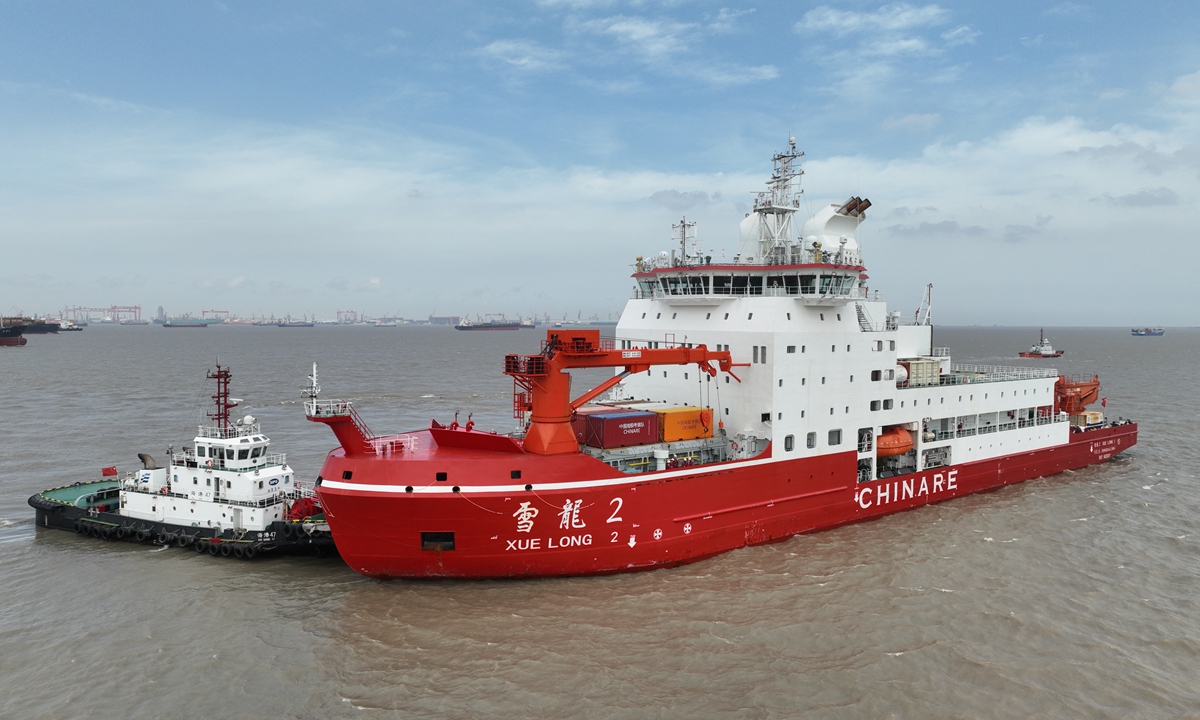
After completing the first stage of comprehensive ocean station surveys on Friday, Xuelong 2 sailed toward higher latitudes and selected a large, relatively flat piece of sea ice about 1.5 meters thick in a densely packed ice zone for its first ice station.
According to Lin Long, captain of the Xuelong 2 sea ice team, the ice station survey conducted by the vessel during this voyage will include six short-term ice stations and one long-term ice station, the Xinhua News Agency reported Sunday.
More than 20 types of scientific operations will be carried out, including the deployment of expendable ice-based buoys, snow and ice-core sampling, under-ice water sampling, sea-ice remote sensing, atmospheric profiling and under-ice oceanographic observations.
Lan Musheng, assistant to the chief scientist of the expedition, said the researchers will comprehensively monitor changes in parameters related to the atmosphere, sea ice, upper ocean and ecological processes beneath the ice as the sea ice melts.
The observations will provide scientific data for studying the rapid changes in Arctic sea ice, the mechanisms behind those changes and the evolution of Arctic ecosystems.
The ice station work is part of China's 16th Arctic Ocean scientific expedition, which was organized by the Ministry of Natural Resources. The expedition set sail from Dalian, Northeast China's Liaoning Province on July 3.
The mission is being carried out by four vessels - Xuelong, Xuelong 2, Jidi and Tansuo-3 - and is expected to be completed in early October.
The expedition is focusing on comprehensive surveys of sea ice, hydrology, biology, ecology and the atmospheric environment in key areas of the Arctic Ocean.
The two icebreakers Xuelong and Xuelong 2 will work together on the ice station surveys. Xuelong completed surveys at 12 ice stations on Friday.
Lin said the ice station locations planned for Xuelong 2 will work in coordination with those of Xuelong to form an observation array.
The arrangement will allow researchers to more deeply investigate the interactions among the atmosphere, sea ice and ocean in the central Arctic Ocean amid rapid environmental changes, as well as their coupling effects with the ecosystem.
The expedition is being conducted against a backdrop of rapid changes in the Arctic environment.
When the mission was launched in July, expedition leader Wang Jinhui said that global warming was driving rapid and profound changes in the Arctic natural environment, with trends such as sea-ice melting intensifying.
The expedition is therefore designed not only to monitor environmental changes but also to investigate frontier scientific questions, including the dynamic evolution of the oceanic crust.
Working on sea ice also presents significant safety challenges. Low temperatures and complex ice-surface conditions can pose risks to researchers, while polar bears are considered the biggest safety risk during ice station operations.
The expedition team has therefore formulated specific bear-prevention and emergency response plans and equipped personnel with various types of bear-deterrence equipment and emergency supplies to ensure their safety.
。

B |
Current article:http://zvpvhi.menjiewugaokuodudipianbeiduan.pics/news/20260826_2478.html
Published on:13:31:49